
GEO vs SEO Explained: What You Need to Know
With the rise of AI-driven tools like ChatGPT, Gemini and Perplexity, the way people search for information online is rapidly evolving. Traditional Search Engine Optimisation (SEO) is no longer the only game in town. A new player is emerging: Generative Engine Optimisation (GEO).
If you’re a small business owning a website, then understanding the difference between SEO and GEO — and how they work together — is crucial for staying relevant in this new era of content discovery.
Video made with FlexClip
What is SEO?
Search Engine Optimisation (SEO) is the practice of improving your website’s visibility on traditional search engines like Google and Bing. The goal is to rank higher in search results and increase organic traffic.
It involves strategies like:
- Researching and using relevant keywords
- Optimising headings, metadata and image alt text
- Creating valuable, user-focused content
- Building backlinks from other reputable websites
- Improving technical performance like page speed and mobile-friendliness
SEO is about helping search engines understand your website so users can find it.
What is GEO?
Generative Engine Optimisation (GEO) is a newer discipline focused on optimising your content to be discoverable by AI-powered generative engines like:
- ChatGPT
- Google Gemini (formerly Bard)
- Microsoft Copilot
- Perplexity AI
These tools answer user questions directly with AI-generated responses, often pulling from a range of sources, without necessarily linking to the original content. That changes the game for marketers and content creators.
GEO strategies aim to make your content:
- Appealing and trustworthy to generative AI models
- Structured with clear, factual information
- Cited or summarised accurately by AI tools
- Optimised for data and schema markup to be machine-readable
- Built for visibility in zero-click answers and conversational AI responses
GEO vs SEO: The key differences
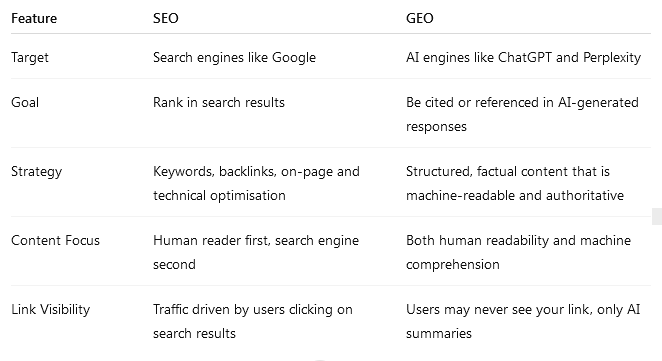
SEO drives clicks, while GEO aims for inclusion and citation in AI responses.
Why GEO now matters
With the rise of zero-click searches and generative answers, more users are getting information without ever visiting a website. AI tools summarise the internet and your content may be used — without attribution — unless it’s optimised for discovery and accuracy.
Generative engines pull content that:
- Is well-structured and factually accurate
- Comes from reputable, frequently updated websites
- Uses clear subheadings, lists, definitions and schemas
- Offers unique insights or expert perspectives
If your content isn’t GEO-optimised, it may be invisible in future search environments.
Related read: 5 Smart Strategies to Get Found in ChatGPT Searches
How to optimise your website for GEO and SEO together
Rather than replacing SEO, GEO builds on it. Here’s how to future-proof your website content:
Structure content clearly
Use headings, bullet points and summaries that are easy for AI to parse.Use schema markup
Implement structured data to help machines understand your content.Cite sources and link internally
Provide context and authority through external and internal linking.Update your content regularly
AI tools favour fresh, trustworthy information.Write fact-rich content
Include stats, definitions and clear answers to user questions.Be authoritative and transparent
Include author bios, credentials and update timestamps.
Final thoughts
SEO helped your website show up on search engines. Now GEO helps your content show up in the answers AI tools give directly to users.
If you want to remain discoverable in both traditional and AI-driven environments, it’s time to think beyond just keywords. Build content that’s helpful, structured and trustworthy, for humans and machines alike.