
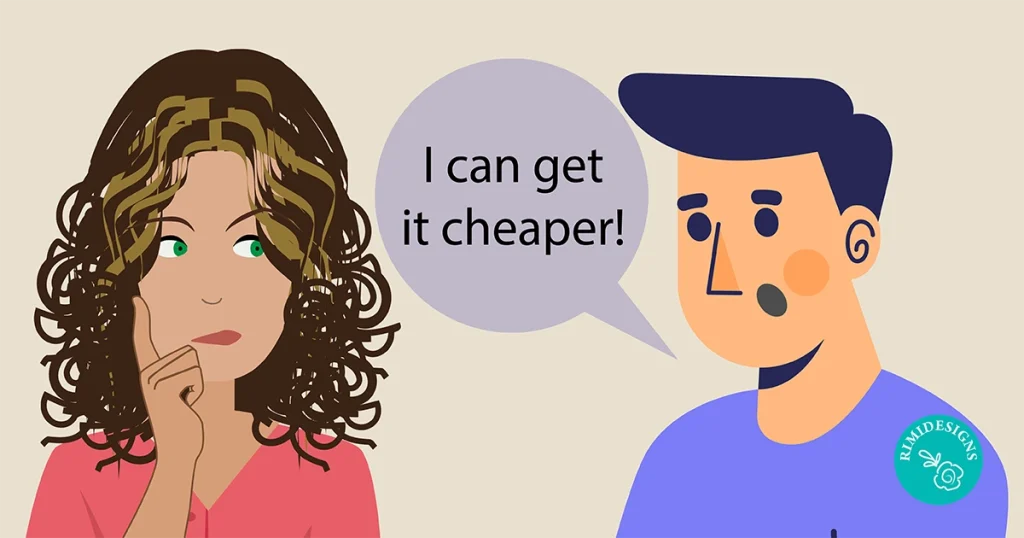
What Do You Do When a Client Says “I Can Get It Cheaper”?
If you run a business, chances are you’ve heard this sentence before, “I can get it cheaper somewhere else.” Price objections are part of doing business. But here’s the important thing: You don’t have to win every customer by being the cheapest.
In fact, competing purely on price can be one of the fastest ways to make your business less profitable, harder to manage and less enjoyable to run.
The better approach is to understand why the client is comparing prices, communicate your value clearly and decide when it’s appropriate to walk away.
Why do clients say “I can get it cheaper”?
When a client says they can get the same thing cheaper, there are several possibilities.
- They may genuinely have received a lower quote.
- They may be testing whether you will lower your price.
- They may not understand the difference between what you offer and what the cheaper provider offers.
- Or they may simply have a budget that doesn’t match your pricing.
Not every price objection means your price is too high. Sometimes, it means your value hasn’t been communicated clearly enough.
Don’t drop your price immediately
One of the biggest mistakes businesses make is immediately responding with: “How much cheaper?” followed by: “Okay, I can match that.”
Before reducing your price, take a moment to understand what the client is actually comparing.
- Are the products or services genuinely identical?
- Does the cheaper option include the same level of expertise?
- Are there differences in quality, materials, experience, turnaround time, communication, warranties, support or after-sales service?
A $500 service and a $1,000 service may look similar on the surface, while delivering very different experiences and outcomes.
The real question isn’t: “Can I match their price?” It’s: “Can I deliver the same value at that price and still run a sustainable business?” If the answer is no, reducing your price may not be the right solution.
Find out what the client is comparing
Instead of becoming defensive, ask a simple question: “Absolutely! Can I ask what’s included in their quote?”
This changes the conversation. Rather than arguing about price, you’re gathering information. You might discover that the cheaper quote doesn’t include important components of your service. For example, a cheaper provider might offer:
- Less experience
- Fewer revisions
- Lower-quality material
- Limited customer support
- A shorter warranty
- Longer turnaround times
- Fewer inclusions
- Less personalised service
- No ongoing support
- Basic rather than customised solutions
Once you understand the comparison, you can explain the differences without criticising your competitor.
Never badmouth the competition
It can be tempting to say: “They’re cheap because they’re not very good.” Don’t! Apart from sounding unprofessional, you may not actually know why their price is lower.
Instead, focus on what you provide. For example: “There can definitely be differences between quotes. Our price includes X, Y and Z, as well as ongoing support after the project is completed.” This keeps the conversation professional and puts the focus back on your value.
Explain what makes your business different
Your potential customer needs a reason to choose you beyond price. Ask yourself: Why should someone pay more to work with my business? Your answer might include:
Experience
Years of experience can reduce mistakes, improve efficiency and help you solve problems faster.
Quality
Higher-quality products, materials or workmanship may cost more initially but can provide greater longevity and reliability.
Expertise
Customers aren’t simply paying for your time. They’re paying for your knowledge, judgement and ability to achieve the desired result.
Service
Fast communication, attention to detail, reliability and a smooth customer experience all have value.
Customisation
A personalised solution can provide significantly more value than an off-the-shelf alternative.
Support
What happens after the customer pays? Follow-up service, maintenance, assistance and warranties can make a significant difference.
These are all reasons why two businesses offering seemingly similar services may legitimately charge very different prices.
Clients are buying outcomes, not just products or hours
One of the most important changes you can make to your sales conversations is to stop focusing exclusively on what you sell. Instead, focus on what the customer gets.
A photographer isn’t simply selling hours with a camera. A designer isn’t simply selling Photoshop or design time. A plumber isn’t simply selling an hour of labour. A consultant isn’t simply selling a meeting.
Customers are buying an outcome. They’re buying confidence, convenience, expertise, quality, reliability, transformation or a solution to a problem. The more clearly you communicate that outcome, the less your conversation becomes a simple price comparison.
Don’t apologise for your price
There is a big difference between explaining your pricing and apologising for it. Avoid statements such as: “I know we’re a little expensive…” Or: “Sorry, but that’s our price.” These statements can unintentionally tell the customer that you believe your price is unreasonable.
Instead, communicate your price confidently. Try: “Our pricing reflects the level of expertise, quality and service included in the project.” You don’t need to be defensive. You simply need to be clear.
Offer options instead of discounts
If the customer’s budget genuinely doesn’t fit your standard offering, consider whether you can adjust the scope rather than simply reducing your price. For example:
- Option A: Full-service package
- Option B: Reduced scope
- Option C: Essential package
This allows the client to choose what works for their budget without automatically devaluing your work. For many businesses, this is a much better strategy than offering an arbitrary discount.
Know when to say “No”
Not every customer is your customer.If someone continually pushes you to reduce your price, questions the value of everything you do and expects premium service at bargain-basement pricing, they may not be the right fit for your business.
Walking away can be difficult, particularly when you’re trying to grow. But an unprofitable customer can cost you far more than the revenue they generate. Your goal isn’t to get every client. Your goal is to attract the right clients.
What should you actually say?
When a client says: “I can get it cheaper”, you could respond: “I completely understand. There will always be businesses offering different prices. Before you make a decision, I’d recommend comparing exactly what’s included. Our price reflects the level of quality, expertise and service we provide, and I’d be happy to explain what’s included in our quote so you can make an informed comparison.”
This response does several things.
- It acknowledges the client’s concern.
- It doesn’t attack the competitor.
- It doesn’t immediately discount your service.
- And most importantly, it shifts the conversation from price to value.
What if they still choose the cheaper option?
Let them. It doesn’t necessarily mean you lost. Sometimes the customer simply isn’t your ideal client. A customer who chooses solely on price may eventually discover that the cheapest option wasn’t the best option. And when they do, they may come back to you.
The key is to remain professional. You can say: “No problem at all. I completely understand that budget is an important consideration. If your circumstances change or you’d like to discuss the project again in the future, we’d be happy to help.”
You never know where that relationship may lead.
Build a brand that isn’t competing on price
The best way to reduce price objections is to build a business that is clearly differentiated. Your website, branding, marketing, portfolio, testimonials, content and customer experience should all communicate the same message: Why you?
If your marketing looks generic and your messaging simply says what you sell, customers may naturally compare you on price. But when your brand clearly communicates expertise, quality, personality, experience and results, the conversation becomes much bigger than a number on a quote.
The cheapest isn’t always the best value
Price and value aren’t the same thing. A cheaper option can sometimes be the best choice. But sometimes paying more upfront can save a customer time, stress, mistakes and additional costs later.
The job of your business isn’t to convince everyone that you’re the cheapest. It’s to make sure the right customers understand why your price represents value.
Conclusion
The next time someone tells you: “I can get it cheaper”, don’t panic. Don’t immediately discount and don’t start criticising your competition.
Instead, ask questions. Understand what they’re comparing. Explain what’s included. Communicate your expertise. Demonstrate the outcome and value you provide.
And if the customer still decides to go elsewhere, let them go professionally. Because a successful business isn’t built by being the cheapest. It’s built by being worth choosing.
FAQ
Stay calm and avoid immediately discounting your price. Ask what the competing quote includes, then explain the differences in your quality, expertise, service, experience, inclusions and customer support.
Not necessarily. First determine whether you’re comparing equivalent products or services. If your costs and required profit margin don’t support the lower price, reducing your price may hurt your business.
Focus on the value and outcomes you provide rather than simply defending your price. Explain factors such as experience, quality, expertise, customisation, reliability, service, warranties and support.
Differentiate your business through strong branding, specialist expertise, quality, customer experience, testimonials, education, personalised service and clearly communicated results.
Only if the discount makes commercial sense. Consider reducing the scope of the project instead of reducing your price for the same amount of work.
Remain professional and don’t take it personally. The customer may have a different budget or priorities. Leave the relationship on good terms because circumstances can change and they may return later.
Build a strong brand and communicate your unique value consistently across your website, social media, advertising, portfolio, testimonials and sales conversations. Make it clear why your business is different before the customer ever asks about price.
Ready to bring your vision to life? Don’t settle for ordinary, let’s design the extraordinary together! Unleash the power of your ideas with stunning visuals. Your masterpiece is just a click away. Think we’d be a great fit? Work with me and let my expert graphic design skills transform your concepts into captivating designs. Let’s talk!